- Cognitive Maintenance: Regular chess play engages executive functions, pattern recognition, and memory, providing a structured mental workout that complements a healthy lifestyle.
- Social Anchoring: Local clubs offer a low-pressure, consistent social environment that helps prevent the isolation often associated with retirement or life transitions.
- Accessibility and Selection: When choosing a club, prioritize accessibility features like proximity to public transport, physical comfort of the venue, and a culture that welcomes varying skill levels.
Engaging in chess at a local club is more than just a game; it is a deliberate strategy for maintaining cognitive sharpness and building a robust social network. For adults aged 60 to 80, the transition into this demographic often comes with a shift in daily structure. Chess clubs offer a unique intersection of intellectual challenge and community interaction that is both accessible and highly rewarding.
The Cognitive and Social Architecture of Chess
Chess is frequently cited in studies regarding neuroplasticity—the brain’s ability to reorganize itself by forming new neural connections. When you play chess, you are not merely moving pieces; you are utilizing your prefrontal cortex for planning, the parietal lobe for spatial visualization, and the temporal lobe for pattern recognition. For an adult in the 60-80 age bracket, this provides a rigorous, yet enjoyable, mental exercise.
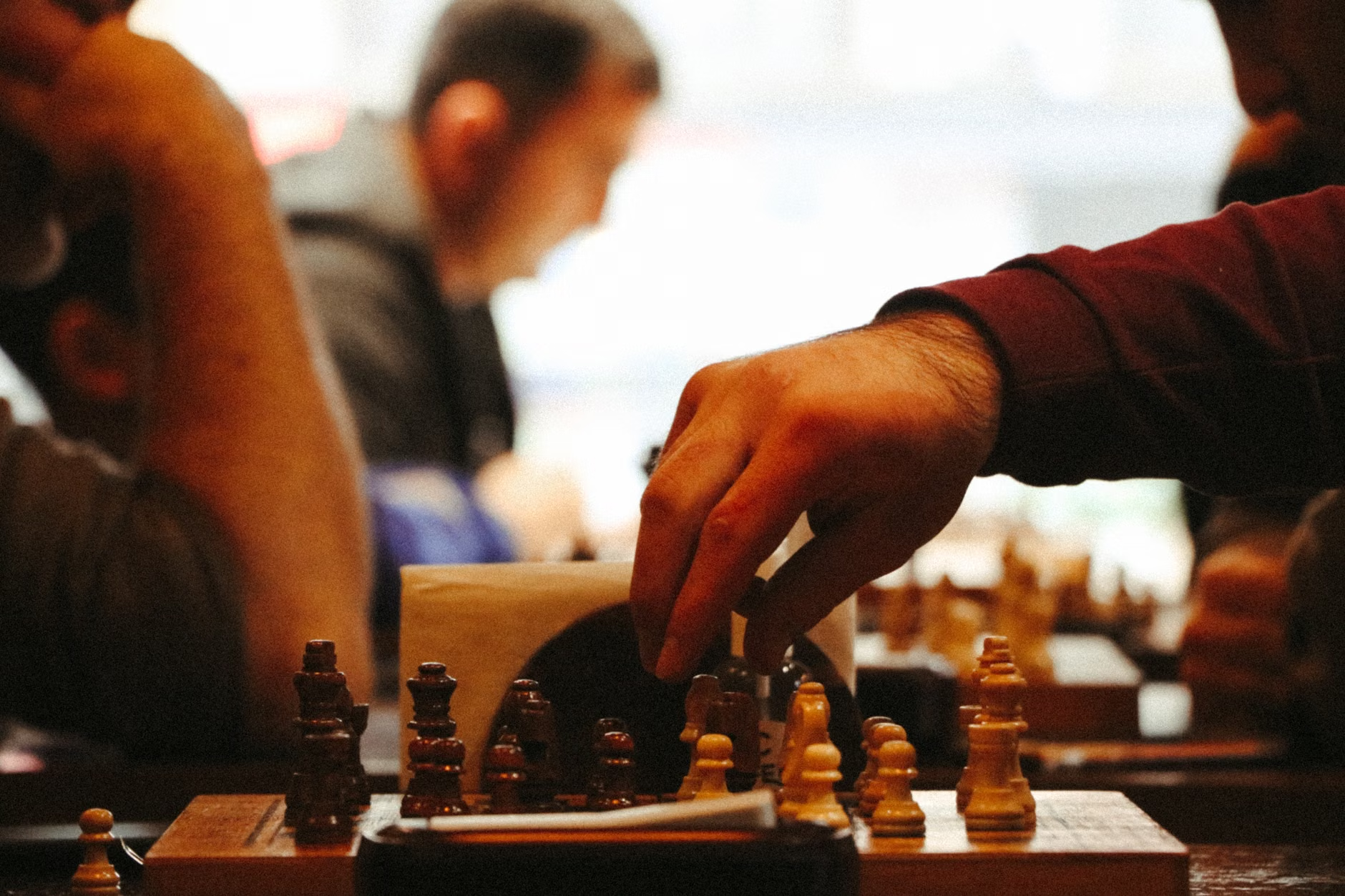
Beyond the internal mechanics of the game, the environment of a club is the primary source of its social value. Unlike solitary digital games, a physical chess club forces interaction. It requires you to greet opponents, negotiate clock settings, analyze positions together, and participate in the shared culture of the club. This social anchoring is vital. Research consistently shows that consistent, face-to-face interactions are more effective in mitigating the effects of social isolation than digital communication.
The “Community Anchor” Effect
A local chess club acts as an “anchor” in your weekly schedule. In a world where routines can fluctuate, having a set time—such as “Thursday afternoons at the community center”—creates a predictable, positive event. This predictability is psychologically grounding. It provides a reason to leave the house, engage with people across different generations, and participate in a shared, rule-based activity that levels the playing field.
Evaluating Potential Clubs: A Practical Decision Framework
Not all chess clubs are created equal. Some are hyper-competitive, focusing on tournament preparation and rapid-fire play, while others are purely social, catering to those who want a leisurely game and a cup of tea. To ensure a positive experience, you must evaluate a club based on your own mobility, stamina, and social preferences.
| Feature | Social-Focused Club | Competitive-Focused Club |
|---|---|---|
| Atmosphere | Relaxed, conversational, slow-paced. | Quiet, intense, timed-game focus. |
| Skill Level | Mixed, beginner-friendly. | Experienced, often rated players. |
| Venue | Cafes, community centers, libraries. | Dedicated halls, tournament rooms. |
| Accessibility | Usually high; prioritize comfort. | Variable; focus on board availability. |
If you are looking for a community to join, start by identifying your primary motivation. If you want to improve your tactical skills, a competitive club might be better, but if you are looking for long-term companionship and a low-stress environment, seek out “social” or “senior-friendly” chess groups. Always visit once as a spectator before committing to a membership.
Accessibility and Physical Considerations
For many in the 60-80 age range, the physical logistics of a club are just as important as the game itself. When researching a location, look beyond the game. Check for the following:
- Transit and Parking: Is the venue near a bus stop or train station? If driving, is there level-access parking?
- Physical Environment: Are the chairs ergonomic? Is the lighting sufficient for comfortable reading of the board?
- Accessibility: Are there stairs? If there are, is there a lift? Check for accessible restroom facilities.
- Stamina Management: Does the club have a policy on break times? Does the atmosphere allow you to leave early without social stigma?

Integrating Chess into Your Daily Wellbeing
To maximize the benefits of chess, consider how it fits into your broader health strategy. Chess should be viewed as one component of a “cognitive hygiene” routine. Just as you might walk for physical health, chess serves as a form of intellectual “cardio.”
The Role of Digital Tools
While physical clubs provide the social connection, digital platforms (such as Lichess or Chess.com) can serve as a bridge. Use these tools to practice specific openings or endgames at your own pace at home. This allows you to walk into your local club feeling more confident, reducing the “performance anxiety” that some new members feel.
Common Mistake: Many people try to master everything at once. Do not attempt to learn complex theory immediately. Instead, focus on playing consistent, slow games. The goal is engagement and social participation, not becoming a Grandmaster.
Addressing Potential Barriers
If you feel intimidated by the idea of joining a group, remember that most clubs are constantly looking for new members. A simple, “I’m looking for a casual game to stay sharp,” is often the best way to introduce yourself. Most clubs will have a “club captain” or organizer who is happy to pair you with someone of a similar temperament.

Deep Dive: The Science of Sustained Engagement
Why does chess specifically work for the 60-80 demographic? It comes down to the concept of cognitive reserve. Cognitive reserve is the brain’s resilience to damage or age-related decline. It is built through lifelong learning and complex, novel activities. Chess is uniquely “novel” because every single game presents a new configuration of pieces and a new set of problems to solve.
Unlike activities that become purely muscle memory, chess requires continuous adaptation. You cannot rely on a fixed routine to win. This forces the brain to remain flexible. When you combine this with the social aspect—the need to read the facial expressions of your opponent, the conversation before and after the game, and the coordination required to travel to the club—you create a “multi-modal” activity that stimulates multiple areas of the brain simultaneously.
Furthermore, the structure of a club provides a buffer against the “loss of role” that can occur after retirement. In a club, you are a “player,” a “member,” or perhaps even an “organizer.” This identity is a powerful psychological tool for maintaining a sense of purpose.
If you have decided to look for a club, follow this practical roadmap to ensure a successful first visit:
- Search Online: Use search terms like “[Your City] chess club” or “[Your Neighborhood] community center activities.”
- Check the Website: Look for a “new members” or “contact” page. Email the organizer to ask if they have a “social hour” or casual sessions.
- Prepare Your Gear (Optional): You do not need to bring a board; most clubs provide them. If you prefer your own, ensure it is portable and lightweight.
- The “Spectator” Visit: Go to the club and sit on the sidelines for the first 30 minutes. Observe the noise level, the age range, and the general vibe. If it feels right, introduce yourself during a break.
- Set Boundaries: If you find the games are too long, ask if they have “blitz” (short games) or if you can play a “friendly” that doesn’t need to be recorded or timed.
Refining Your Approach: Beyond the Basics
As you become more comfortable, you may find that your interests shift. You might become interested in the history of the game, or perhaps you want to help organize a local tournament. This is where the social value truly deepens. By moving from a “participant” to a “contributor” within your club, you increase your social integration and sense of belonging.
Avoid the temptation to compare yourself to younger, highly competitive players. The value of the club for you is not in the Elo rating (a measurement of skill), but in the quality of the interaction and the mental stimulation provided. If you find yourself becoming stressed by the competitive nature of a particular club, do not hesitate to look for a different group. The “social fit” is just as important as the game itself.
Finally, remember that your health is the foundation of all your activities. If you are feeling fatigued, it is perfectly acceptable to skip a week. The club will be there when you return. Consistency over time is far more valuable than intensity in the short term.
Conclusion: The Long-Term Perspective
Local chess clubs are a low-cost, high-reward investment in your long-term wellbeing. They provide a structured environment for cognitive exercise while simultaneously building the social bonds that are essential for a healthy, active life in your 60s, 70s, and beyond. By carefully selecting a club that matches your personal needs—whether that be a quiet, social environment or a more structured, competitive one—you can ensure that chess becomes a sustainable and enriching part of your weekly routine. Start with a simple inquiry, take your time, and enjoy the process of learning and connecting.
Frequently Asked Questions (FAQ)
1. Do I need to be good at chess to join a local club?
Not at all. Most local clubs welcome players of all skill levels, from absolute beginners to advanced players. Many clubs hold dedicated sessions for those who are just learning the rules or want to play casually. When you contact a club, it is perfectly acceptable to state, “I am a beginner and looking for a friendly environment to learn.”
2. Is there a cost associated with joining a chess club?
This varies by jurisdiction and the type of organization. Many clubs that meet in public libraries or community centers are free or have a very small nominal fee to cover room rental or refreshments. Private or tournament-focused clubs may charge a monthly or annual membership fee. Always ask about the fee structure before your first visit.
3. What should I do if I have mobility issues?
Accessibility varies by venue, so it is crucial to ask specific questions before you go. Ask the club organizer about the presence of elevators, the distance from the parking area to the meeting room, and whether the venue has accessible restrooms. Most public community centers are required to meet accessibility standards, but it is always safer to confirm these details in advance.
For further information on finding community groups, you may consult your local government’s community services page or national resources such as Age UK (for the UK) or similar regional departments on aging in your specific country.