- Prioritize Stability: Always perform seated twists on a stable, non-rolling chair with feet firmly grounded to protect the lumbar discs.
- Focus on Lengthening: The goal is to rotate around a tall, elongated spine rather than forcing a deep twist, which minimizes shear stress on the vertebrae.
- Listen to Your Body: If you feel sharp, shooting pain or numbness, stop immediately; these are indicators that you may be moving beyond your current range of motion or irritating a nerve.
Understanding Lumbar Rotational Range and Why It Matters
As we navigate our 60s, 70s, and beyond, the health of our spine—specifically the lumbar region (the lower back)—becomes a cornerstone of functional independence. The lumbar spine is designed for stability and support, but it also relies on a degree of rotational flexibility to allow us to perform daily tasks like turning to look behind us while driving, reaching for a seatbelt, or grabbing an item from a shelf. When this range of motion diminishes, we often compensate by over-rotating our hips or straining our shoulders, which can lead to stiffness and discomfort.
A seated spinal twist is a low-impact, controlled movement that helps maintain the mobility of the thoracic and lumbar spine. Unlike standing twists, which require significant balance and core engagement, the seated variation removes the challenge of maintaining equilibrium, allowing you to focus entirely on the quality of the movement. By understanding how to perform this safely, you can incorporate a simple preventive habit into your daily routine that supports spinal health.
The Mechanics of the Lumbar Spine
The lumbar spine consists of five large vertebrae (L1 to L5). These vertebrae are separated by intervertebral discs that act as shock absorbers. Unlike the thoracic spine (the mid-back), which is built for rotation, the lumbar spine is structurally designed to resist excessive rotation. This is a vital protective mechanism. When we talk about “rotational range,” we are not aiming for a deep, wringing-out motion; rather, we are aiming for a gentle, controlled glide that keeps the surrounding musculature supple.
In real-life scenarios, such as turning to check traffic before changing lanes, the movement involves the entire kinetic chain. If your thoracic spine is stiff, your lumbar spine often “borrows” that movement, leading to repetitive micro-trauma. By keeping the spine mobile, you distribute the effort of daily movement more efficiently, reducing the likelihood of localized strain.
Establishing the Foundation: Safety and Preparation
Before attempting any spinal movement, the environment and your physical setup are paramount. A common mistake is practicing on a swivel chair or a chair with wheels, which can slip unexpectedly. Always ensure your chair is stationary and placed on a non-slip surface.
| Component | Requirement for Safety | Why it Matters |
|---|---|---|
| Chair Selection | Stable, non-swivel, no wheels | Prevents accidental falls or loss of balance. |
| Foot Placement | Hip-width, flat on the floor | Provides a solid anchor for the pelvis. |
| Spinal Alignment | Neutral spine (not slumped) | Protects discs from uneven compression. |
| Breathing | Deep, rhythmic inhalation/exhalation | Prevents breath-holding, which increases blood pressure. |
If you find it difficult to sit with a neutral spine, consider placing a small lumbar roll or a firm cushion behind your lower back. This encourages the natural curve of the lower back and prevents the common “C-shaped” slouch that puts unnecessary pressure on the vertebral discs.

Step-by-Step Execution of the Seated Spinal Twist
The following sequence is designed to be performed at a slow, controlled pace. Do not rush through these steps. The goal is to feel the muscles working, not to achieve a specific “look” or depth.
1. The Initial Alignment
Sit at the front third of your chair. Plant your feet firmly on the ground, hip-width apart. Imagine a string pulling the crown of your head toward the ceiling; this “lengthening” action is the most important part of the exercise. By creating space between the vertebrae, you reduce the pressure on the discs before you even begin the rotation.
2. The Controlled Rotation
Place your right hand on the backrest of the chair or the outside of your left thigh. Keep your left hand on your hip or resting on the chair seat. As you inhale, lengthen your spine. As you exhale, begin to turn your torso toward the back of the chair. Crucial point: Initiate the movement from your mid-back, not your lower back. Your gaze should follow the direction of your chest, not your neck.
3. The Return and Release
Hold the position for only 5 to 10 seconds. Focus on maintaining the length you created in step one. To release, slowly return your torso to the center on an inhalation. Repeat on the other side. If you feel any dizziness or resistance, stop immediately. It is better to perform a smaller, pain-free rotation than a wide, strained one.
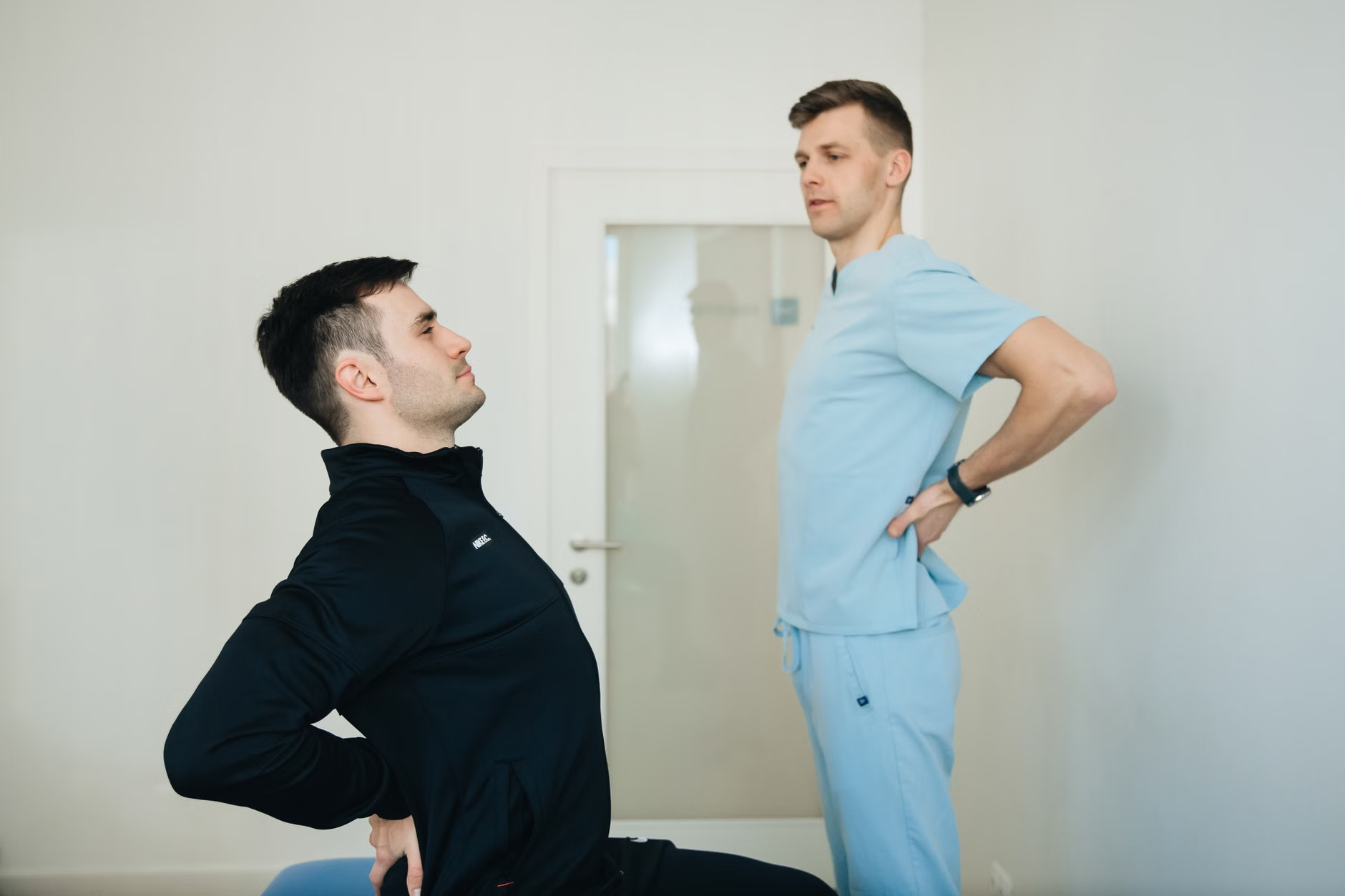
Common Mistakes and How to Avoid Them
Understanding what to avoid is just as important as knowing what to do. Many people approach spinal exercises with the “no pain, no gain” mentality, which is counterproductive and potentially dangerous for the lumbar spine.
- The “Neck-Only” Twist: A frequent error is turning the head and neck while the torso remains stationary. This creates torque on the cervical spine without actually mobilizing the lumbar region. Keep your head in line with your chest throughout the movement.
- Forceful Pulling: Using your hands to “yank” your body into a deeper twist is a common cause of strain. Your arms should provide gentle guidance, not force. If you find yourself holding your breath to twist further, you have gone too far.
- Ignoring the Pelvis: If your hips shift or your knees knock together during the twist, you are losing the stability of your base. Keep your knees aligned over your ankles and your weight evenly distributed across both sitting bones.
When to Consult a Professional
If you have a history of spinal conditions, such as herniated discs, spinal stenosis, or osteoporosis, you should consult with a physical therapist or a physician before adding new movements to your routine. A physical therapist can perform a clinical assessment to determine which specific ranges of motion are safe for your unique spinal structure.
Warning Signs: If you experience any of the following during or after the exercise, stop immediately and seek medical advice:
- Sharp, stabbing pain in the lower back.
- Radiating pain, tingling, or numbness in the legs or feet.
- Dizziness or lightheadedness that persists after returning to a neutral position.
- Pain that does not subside after a few minutes of rest.

Integrating Mobility into Daily Life
Preventive health is not about “working out” for an hour; it is about the consistent, low-intensity movements we do throughout the day. The seated spinal twist can be integrated into your routine during times when you would otherwise be sedentary.
For example, if you spend time reading or using a computer, set a timer for every 30 to 45 minutes to stand up, stretch, and perform a gentle seated twist. This breaks up long periods of immobility, which is known to contribute to spinal stiffness. The “micro-break” concept is highly effective for maintaining range of motion without causing fatigue.
The Role of Hydration and Nutrition
While exercise is vital, spinal health is also supported by the hydration of your intervertebral discs. The discs are primarily composed of water. Staying well-hydrated helps maintain the turgor (pressure) within the discs, which supports their ability to absorb shock. While no specific food “cures” back pain, a diet rich in anti-inflammatory nutrients—such as omega-3 fatty acids found in fish, flaxseeds, and walnuts—can support overall tissue health, including the muscles and ligaments surrounding the spine.
Comprehensive Comparison: Types of Spinal Mobility Movements
Not all spinal movements are created equal. It is helpful to understand how the seated twist fits into a broader movement strategy.
| Movement Type | Primary Benefit | Best For | Risk Level |
|---|---|---|---|
| Seated Twist | Rotational mobility | General maintenance, desk workers | Low |
| Cat-Cow (on hands/knees) | Flexion/Extension | Overall spinal flexibility | Moderate (requires knee health) |
| Pelvic Tilts | Lumbar stability | Core activation, lower back pain | Very Low |
| Standing Side Bends | Lateral mobility | Rib cage expansion | Moderate (requires balance) |
As the table illustrates, the seated twist is uniquely suited for those who prioritize safety and convenience. If you have limited balance or knee issues, the seated twist is significantly more accessible than movements that require getting down on the floor.
Advanced Nuances: The “Hidden” Variables of Spinal Health
One often overlooked variable in spinal health is the state of your hip flexors. If your hip flexors are tight—which is common in people who spend a significant amount of time sitting—they can pull on the pelvis and create a forward tilt. This tilt changes the alignment of the lumbar spine, making it much harder to perform a healthy rotation. Therefore, performing a gentle hip flexor stretch before your spinal twist can significantly improve the quality of your movement.
Another nuance is the “breath-movement coordination.” Most people hold their breath during exertion. However, in yoga and physical therapy, the emphasis is on exhaling into the effort. By exhaling as you twist, you engage your transverse abdominis—the deep core muscle that acts as a natural corset for your spine. This engagement provides active protection for your lumbar vertebrae during the rotation.
There is a distinct difference between “stiffness” and “pathology.” Stiffness is often a result of inactivity or age-related changes in tissue elasticity. Pathology, however, involves structural damage. If you feel that your range of motion has decreased significantly over a short period (weeks rather than years), or if you experience “locking” of the back, this warrants a visit to a GP or a physical therapist. They can differentiate between muscular tension and potential joint-related issues.
When you visit a professional, be prepared. Bring a list of your daily activities, any specific movements that trigger discomfort, and a record of how long the discomfort lasts. This helps the professional provide a more accurate assessment. Remember, the goal of professional care is not just to treat pain, but to provide you with the tools to manage your own mobility safely.
The Long-Term Perspective
Maintaining lumbar rotational range is a lifelong project. It is not something that is “fixed” in a week. By adopting a gentle, consistent approach, you are investing in your future ability to move through the world with ease. Focus on the quality of your alignment, the depth of your breath, and the consistency of your practice. Over time, these small, deliberate actions compound into significant improvements in your daily quality of life.
Remember that your body changes as you age, and your exercise routine should adapt with it. What felt easy at 50 may require more focus at 75. That is not a sign of failure; it is a sign of wisdom in practice. Listen to your body, respect its current limits, and continue to move with intention and care.
Resources for Further Learning
- National Institute on Aging: Exercise and Physical Activity – A comprehensive guide on the four types of exercise for older adults.
- Physiopedia: Lumbar Spine – Detailed clinical information on the anatomy and function of the lumbar spine.
Frequently Asked Questions
- How often should I perform these seated twists?
For most adults, performing these twists once or twice daily is sufficient. The key is consistency rather than intensity. If you find your back feeling stiff after long periods of sitting, a quick session can be very beneficial. - Can I do this if I have had back surgery?
If you have a history of spinal surgery, you must consult your surgeon or a specialized physical therapist before starting any new movement program. They can advise on which ranges of motion are safe for your specific recovery status. - Is it better to do this in the morning or the evening?
There is no “perfect” time. However, many people find that doing them in the morning helps “wake up” the spine after sleep, while others prefer the evening to release the tension accumulated throughout the day. Choose the time that fits best into your routine to ensure you actually do it.