The safest rule after a power cut is simple: keep refrigerator and freezer doors closed, write down when the power failed, and never taste food to decide whether it is safe. Adults aged 65 and older are more likely to become seriously ill from food poisoning, so a cautious plan matters more than saving a few uncertain items.
- An unopened refrigerator keeps food cold for about 4 hours.
- A full unopened freezer holds temperature for about 48 hours; a half-full one for about 24 hours.
- When safety cannot be confirmed by time and temperature, throw the food away—do not taste it.
This guide turns official United States food-safety advice into a practical plan that can be adapted anywhere. Local emergency alerts and public-health instructions always take priority, especially after flooding or a drinking-water warning.
Why older adults need a stricter plan
The US Centers for Disease Control and Prevention (CDC) lists adults aged 65 and older among the groups at increased risk of severe foodborne illness. Ageing can change how effectively the immune system and organs respond to harmful germs. A person living with diabetes, kidney disease, liver disease, cancer treatment or another condition that weakens immunity may face additional risk.
This does not mean every older person is frail. It means uncertain leftovers, milk, meat or eggs are a poor place to gamble. A written plan also reduces the pressure to remember complicated rules in the dark.
Before an outage: make a low-cost food-safety kit
Preparation does not require an expensive generator. Start with one appliance thermometer for the refrigerator and one for the freezer. The refrigerator should normally be at or below 40°F (4°C), and the freezer at or below 0°F (-18°C).
| Item | Why it helps | Where to keep it |
|---|---|---|
| Appliance thermometers | Shows whether food stayed cold | Inside refrigerator and freezer |
| Battery torch | Prevents falls and reduces door-open time | Easy-to-reach drawer |
| Paper and marker | Records outage start and door openings | On or beside refrigerator |
| Frozen gel packs | Keeps a cooler at 40°F/4°C or below | Freezer |
| Cooler | Protects priority foods during a long outage | Accessible cupboard |
| Manual can opener | Opens shelf-stable food without power | Kitchen drawer |
Freeze containers of water with room for expansion. Group frozen food together so it retains cold longer. Keep a few shelf-stable meals that suit your dietary needs, plus bottled water where flood water cannot reach it.
If medicine requires refrigeration, keep it separate from food decisions. Ask a pharmacist or the manufacturer in advance what temperature range and emergency steps apply. Do not move medicine to ice without product-specific advice because freezing can damage some medicines.
When the power goes out: the first 10 minutes
- Note the time. Write the outage start on paper.
- Close the doors. Do not repeatedly check whether the light is back.
- Check official alerts. Use a charged phone or battery radio for outage, heat and water notices.
- Make a person-first plan. If the home is dangerously hot or cold, move to a safe location. Food comes second.
- Call a support person early. Ask about transport, ice or a safe meal before conditions worsen.
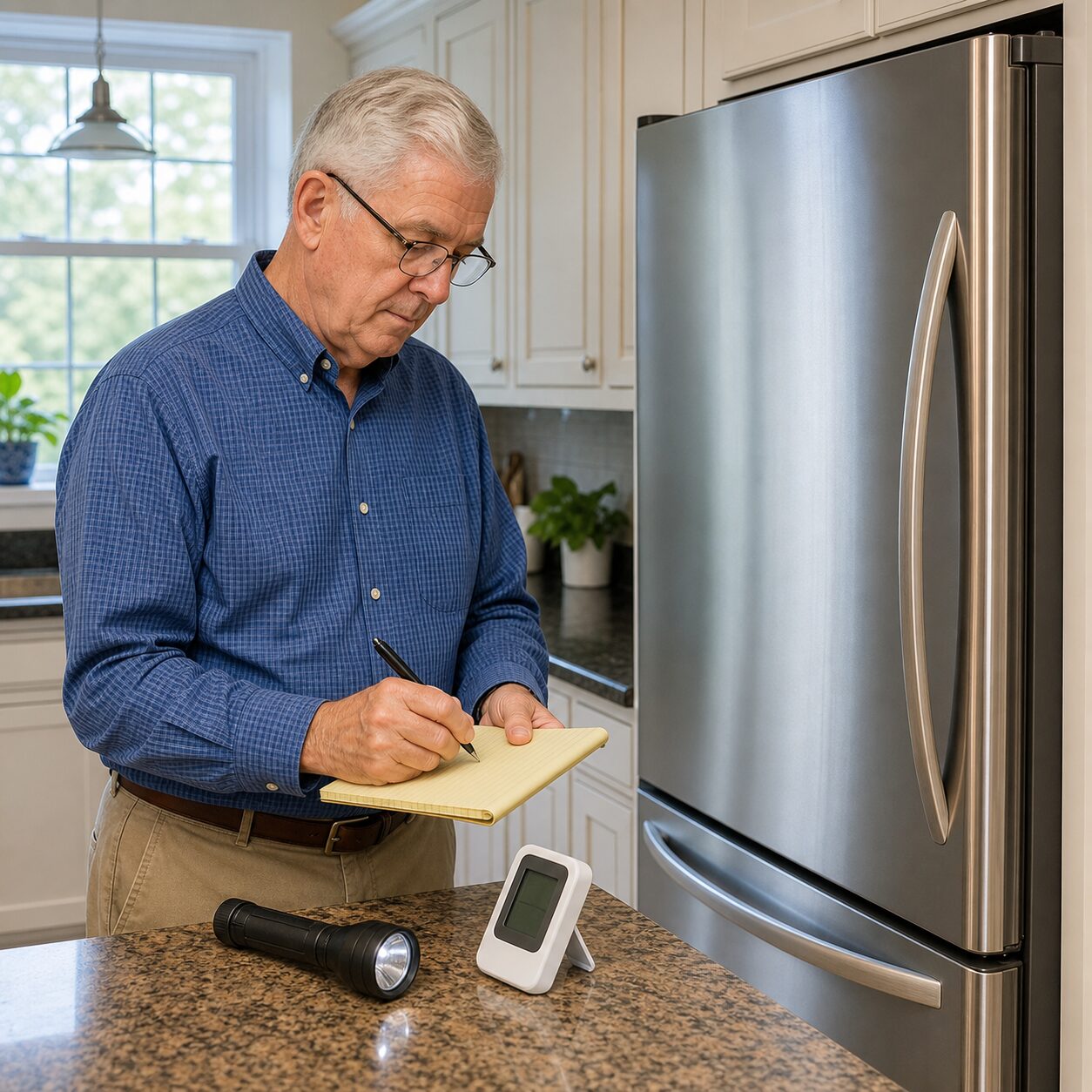
The refrigerator and freezer clock
| Appliance | If the door stays closed | Action |
|---|---|---|
| Refrigerator | About 4 hours | After that, protect priority food in a cooler at 40°F/4°C or below, or discard unsafe perishables |
| Full freezer | About 48 hours | Keep closed; check temperature or ice crystals when power returns |
| Half-full freezer | About 24 hours | Keep closed; group packages if this can be done quickly and safely |
These times are not permission to ignore temperature. They assume doors remain closed. A warm room, repeated opening or an appliance that was already too warm can shorten the safe window.
If officials expect an outage longer than four hours, transfer only priority refrigerated foods to a cooler with ice or frozen gel packs. Keep the cooler at or below 40°F (4°C), verify it with a thermometer, and place it in the coolest safe part of the home. Dry ice can cause burns and carbon-dioxide hazards; use it only with proper ventilation and handling instructions.
What to discard after refrigeration is lost
FoodSafety.gov says to discard refrigerated perishable foods such as meat, poultry, fish, eggs and leftovers after four hours without power. Milk, soft cheeses, cut fruit, cooked rice, casseroles and opened refrigerated products may also need disposal when they have been too warm for too long. Use the official item-by-item chart rather than memory.
Never rely on smell, appearance or a small taste. Harmful germs may not change any of them. Cooking also does not reliably rescue every food that has been stored unsafely.
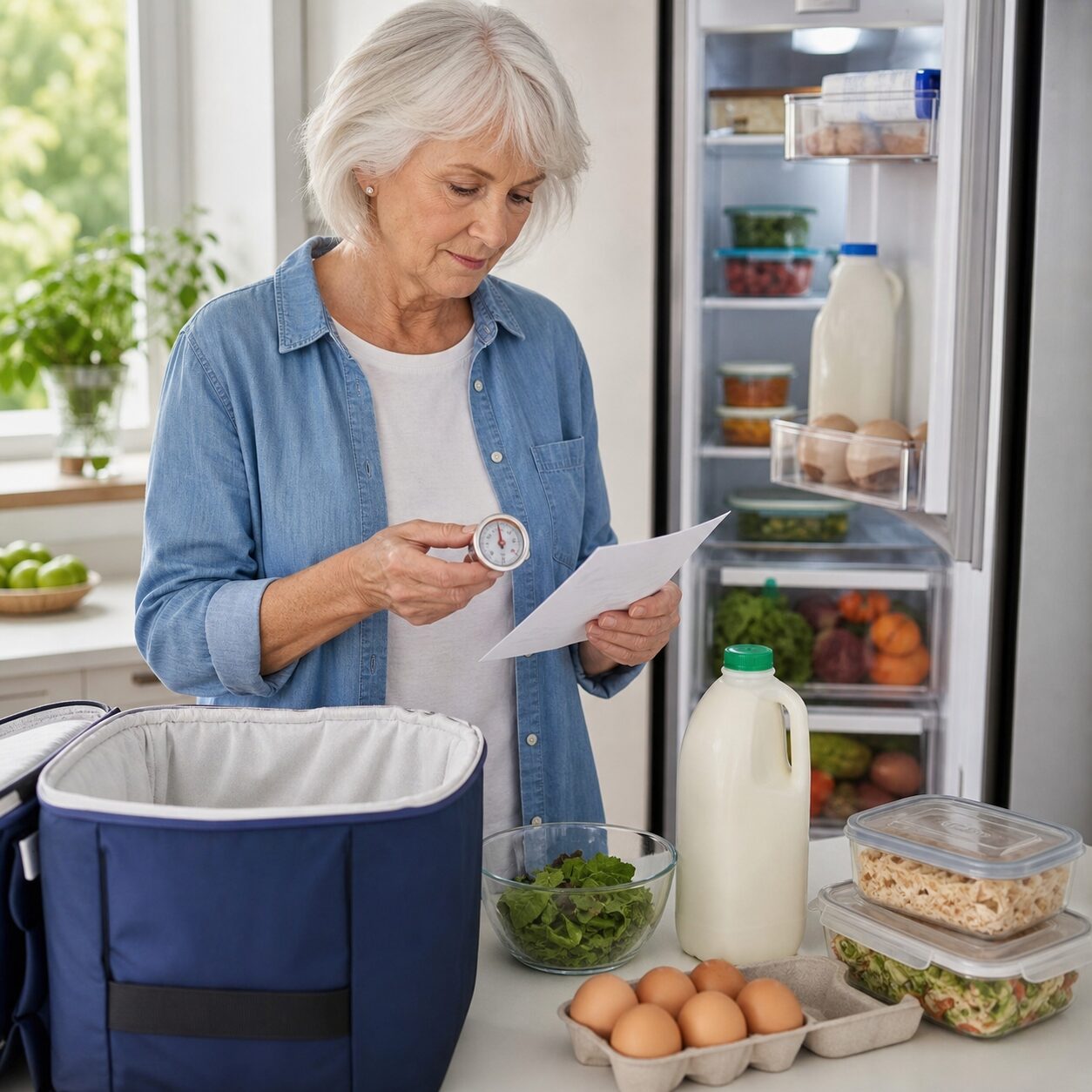
When power returns: use this decision sequence
- Write down the restoration time.
- Read the appliance thermometer before opening doors for long.
- For frozen food, look for ice crystals and confirm it is 40°F (4°C) or below. FDA guidance says such food may be refrozen or cooked, although quality may decline.
- Discard refrigerated perishables that were above 40°F (4°C) for four hours or more.
- Clean spills, then wash hands before handling safe food.
- Photograph discarded food and keep receipts if an insurer or assistance programme requests evidence.
Do not fill the refrigerator immediately with warm leftovers. Allow the appliance to return to its normal safe temperature and confirm that it stays there. If it does not cool properly, arrange repair and use another safe storage method.
Flood water changes the rules
Food or drinking containers touched by flood water require special caution. Discard food in cardboard boxes, screw-top jars, snap lids and other containers that cannot be reliably sanitised. Follow local authorities on drinking water. Do not assume a household filter makes contaminated water safe.
Keep shelf-stable food and bottled water on high shelves before storms. If flood water entered the kitchen, use official FDA or local public-health cleaning instructions and avoid electrical appliances until authorities say the area is safe.
A plan for limited mobility, vision or memory
Use large-print labels on the refrigerator: “Keep closed” and “Outage began: ____”. Store the torch between the bedroom and kitchen, not in a hard-to-reach high cupboard. A talking thermometer or high-contrast digital display may be easier to read.
Choose two contacts: one nearby person who can bring ice or a meal, and one person outside the area who can coordinate if local networks are busy. Agree that nobody should lift a heavy cooler alone. Divide food into smaller containers before storm season so it is easier to move.
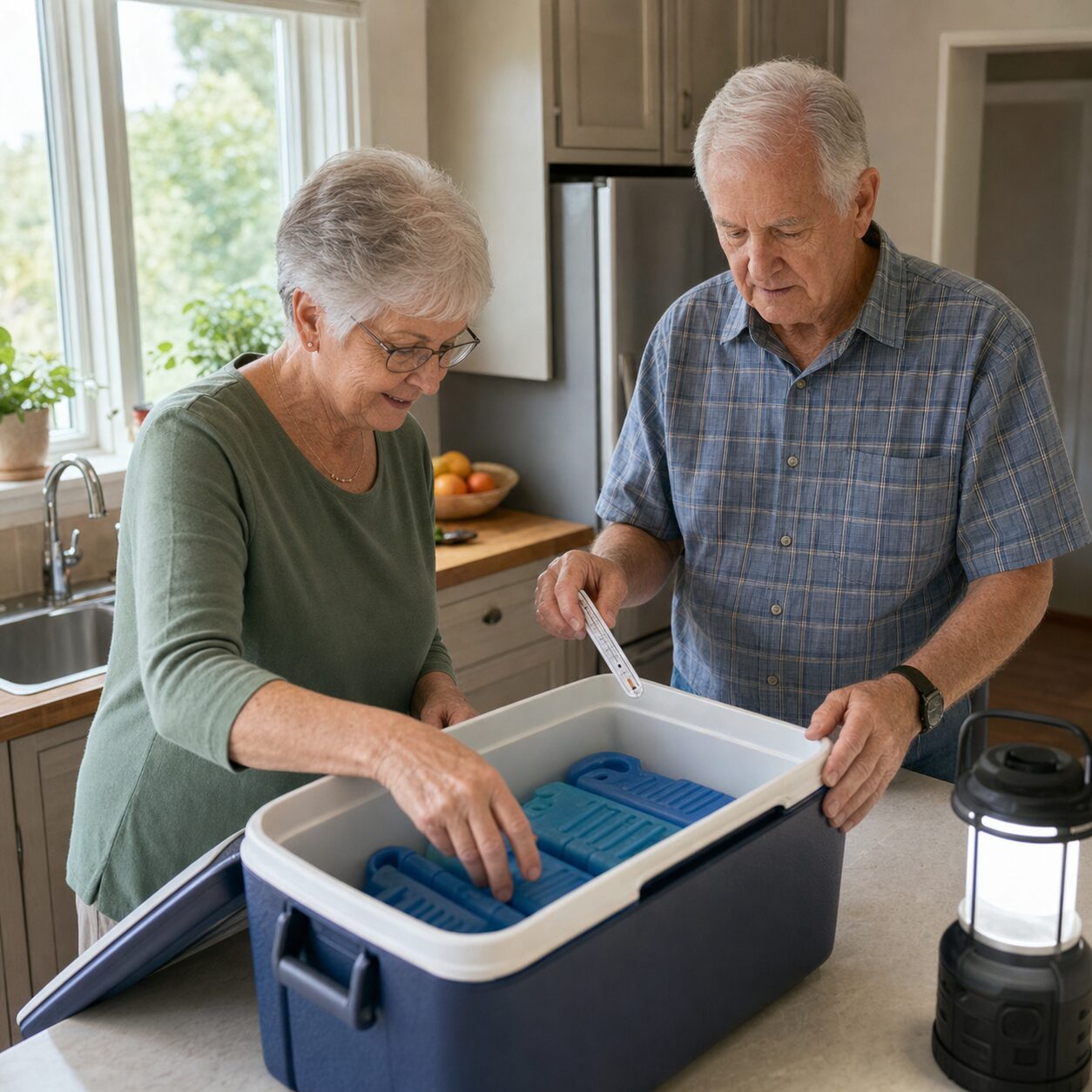
One-page checklist
- Thermometers show refrigerator ≤40°F/4°C and freezer ≤0°F/-18°C.
- Gel packs and water containers are frozen.
- Cooler, torch, batteries and manual opener are accessible.
- Outage start time is written down.
- Doors remain closed.
- Long-outage plan identifies safe meals, ice and transport.
- Uncertain food is discarded without tasting.
- Flood and drinking-water alerts are checked.
- Medication storage is confirmed separately with a pharmacist.
Official sources
- US FDA: Food and Water Safety During Power Outages and Floods
- FoodSafety.gov: Food Safety During a Power Outage chart
- CDC: People at Increased Risk for Food Poisoning
- CDC: What to Do During a Power Outage
Frequently asked questions
FAQ: Can I taste a small amount to check it?
No. Taste, smell and appearance cannot confirm that food is safe. Use time, measured temperature and the official food chart. When in doubt, throw it out.
FAQ: Is food safe if the power was out for less than four hours?
Refrigerated food is generally expected to remain cold for about four hours if the door stayed closed, but check the thermometer and circumstances. If food was already warm or the door opened repeatedly, be more cautious.
FAQ: Can I refreeze food that has started thawing?
FDA guidance says frozen food that still has ice crystals or is 40°F (4°C) or below may be refrozen or cooked. Quality may decline. Discard food when safe temperature cannot be confirmed.
This article provides general preparation information, not individual medical advice. Seek prompt professional care for severe vomiting or diarrhoea, signs of dehydration, bloody diarrhoea, high fever, confusion, fainting or other urgent symptoms.