Quick take: Medicine rules are not the same in every country. Check the destination before departure, keep medicines in hand luggage in their original labelled containers, and carry a clear medicine list plus supporting documents. Ask a clinician or pharmacist before changing doses or timing.
Three key takeaways
- Check legality first: a medicine that is routine at home may be restricted abroad.
- Prepare for disruption: carry enough for the trip and a reasonable delay, where prescribing and destination rules allow.
- Keep the plan understandable: use generic medicine names, doses, reasons for use, allergies and emergency contacts.
International travel remains a priority for many adults over 50 in 2026, even as costs and transport disruption influence plans. For older travellers who use several medicines, a little preparation can prevent a lost bag, time-zone change or border question from becoming a health emergency.
1. Check the destination’s medicine rules
Start with the embassy, consulate, health ministry or customs authority of every country on the itinerary, including transit stops. Look for quantity limits, controlled-drug permits, original-packaging rules and whether a doctor’s letter must contain specific details. Airline security rules and import rules are separate: passing airport screening does not automatically mean a medicine can legally enter the country.
| Question | Where to verify | Record |
|---|---|---|
| Is the medicine restricted? | Destination embassy, health ministry or customs | Official URL and date checked |
| Is a permit or letter required? | Destination authority | Document format and deadline |
| Can liquid medicine exceed cabin limits? | Airport or aviation-security authority | Screening procedure |
| How should needles or devices travel? | Airline and security authority | Packaging and declaration steps |
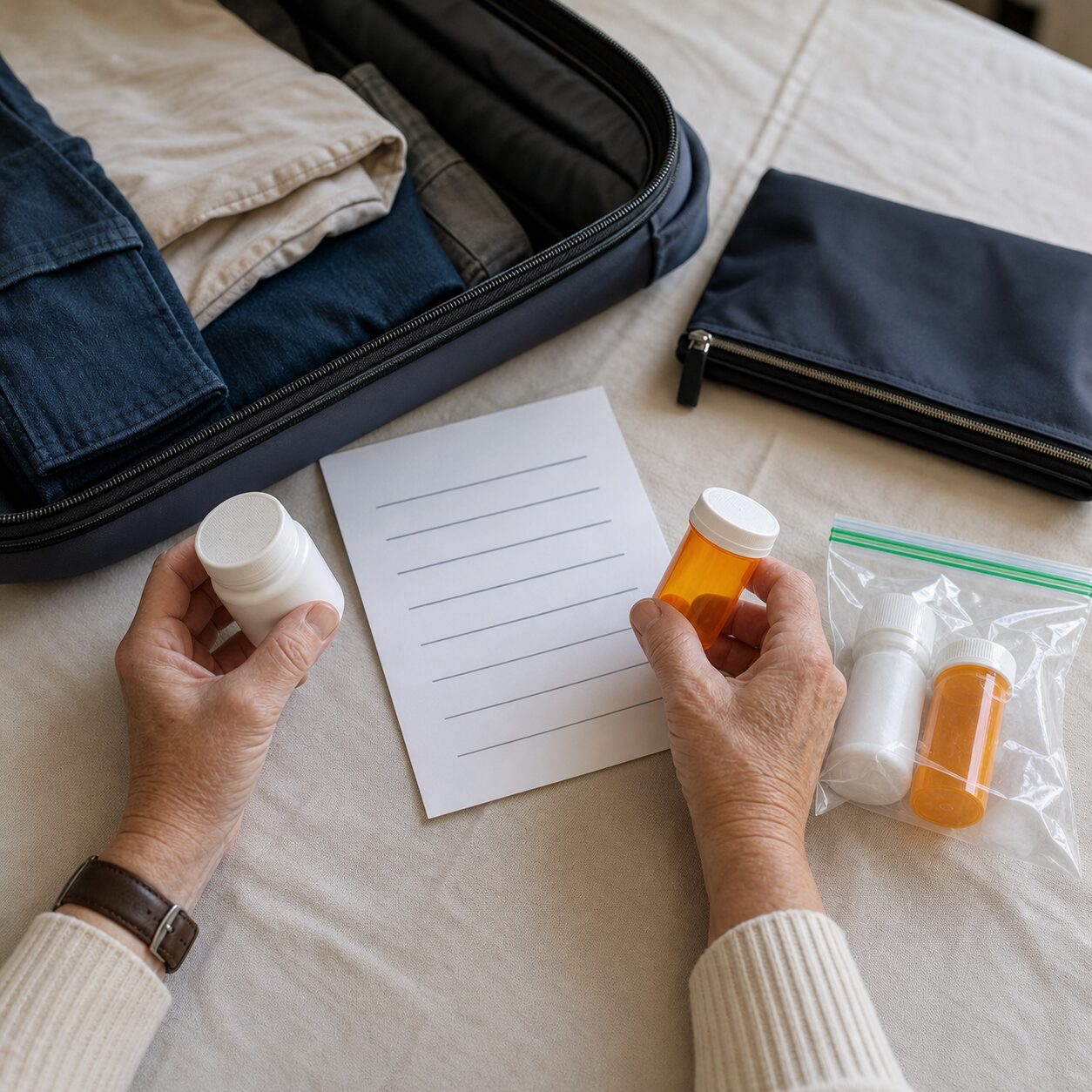
2. Arrange a medicine review before departure
Book early enough to resolve refills, monitoring or paperwork. Bring the itinerary, including time zones, climate, altitude and expected activity. Ask a clinician or pharmacist to review possible travel issues such as drowsiness, falls, dehydration, sun sensitivity, storage temperature and interactions with travel vaccines or over-the-counter remedies.
Do not stop, split, double or reschedule a prescription on your own. A time-zone plan depends on the medicine and the person. Write down the agreed plan rather than relying on memory after a long flight.

3. Build a plain-language medicine record
List each medicine’s generic name, brand name if useful, strength, dose, schedule and reason for use. Add allergies, important conditions, the prescriber’s contact details and an emergency contact. Generic names matter because brands vary between countries. Keep a paper copy with the medicines and an encrypted or securely stored digital copy available offline.
4. Pack for loss and delay
Keep essential medicines in the personal item or cabin bag, not only in checked luggage. Use original labelled containers unless official destination guidance says otherwise. Separate a small backup supply between two permitted carry-on locations when practical, but never give controlled medicines to another traveller to carry without confirming the law.
- Bring only quantities permitted by every destination.
- Keep prescriptions and letters easy to reach at inspection.
- Protect tablets from moisture and crushing.
- Carry necessary measuring devices, batteries or charging cables.
- Keep a few doses accessible without opening an overhead locker.

5. Protect medicines from heat and cold
Cars, luggage holds and sunny windows can become very hot. Some medicines also must not freeze. Follow the storage instructions supplied with the medicine and ask a pharmacist about a suitable travel container. Do not place medicine directly against ice unless specifically instructed; condensation and freezing may cause damage. If temperature control is critical, ask how long the medicine may remain outside its usual range and how to recognise a compromised product.
6. Use a written time-zone plan
Set alarms only after the clinician or pharmacist has confirmed the schedule. Keep one clock set to the reference time until the transition is complete. For flights crossing many zones, write the local date, local time and dose in a small log. This reduces the chance that fatigue leads to a missed or repeated dose.
7. Know what to do if medicine is lost
Save the travel insurer’s assistance number and identify reputable medical facilities or pharmacies at the destination. If medicine is lost, contact a licensed local clinician or pharmacist and the insurer; do not buy from street sellers or an unfamiliar marketplace. Replacement rules vary, and a home prescription may not be valid abroad.
Departure-day checklist
- Destination and transit rules checked on official sites.
- Required permits or medical letters packed.
- Medication list updated with generic names.
- Allowed supply packed in original labelled containers.
- Essential medicine placed in hand luggage.
- Storage and time-zone plans written down.
- Insurance, clinician and emergency contacts saved offline.
Frequently asked questions
Can I use a pill organiser when travelling internationally?
It may be convenient during the trip, but border authorities may expect original labelled packaging. Check the destination’s official rules and keep the original containers and documentation available.
Should I pack extra medicine?
A modest delay supply can be sensible, but only within prescription limits and the import rules of every destination. Ask the prescriber and check official quantity limits.
What if my medicine needs refrigeration?
Ask the pharmacist for the exact permitted temperature range and an appropriate travel method. Confirm airline arrangements in advance and never assume hotel refrigerators maintain a medical-grade temperature.
Official sources
- CDC: Older Adults and Healthy Travel
- U.S. Department of State: Your Health Abroad
- NHS: Taking medicines abroad
- WHO: International Travel and Health
- AARP: 2026 Travel Trends for Adults 50 and Older
This article gives general preparation information, not individual medical or legal advice. Medicine rules and clinical needs vary by country and person.