The success of blood sugar management is decided not by how little you eat, but by the specific order and quality of every single bite you take.
📋 THE 3-LINE CORE SUMMARY
- Focus on Glycemic Load (GL) rather than just the Glycemic Index (GI) to understand the real impact of portion sizes.
- Adopt the Fiber-Protein-Carb eating sequence to create a natural buffer that prevents dangerous glucose spikes.
- Beware of healthy-looking traps like fruit juices or ground grains which hit your bloodstream like a sugar bomb.
When the doctor first delivered the news about my father’s diabetes diagnosis, my heart dropped. It felt like a heavy weight settled in my chest, and for a moment, I couldn’t even process what he was saying. My father had always been so energetic, so the shock was profound. But then, a second realization hit me like a cold wave: I carry those same genes. That day was a turning point. I stopped being a passive observer and became an obsessive health information collector. I am Cooldy, and while I am not a doctor, I have spent countless nights scouring research papers and clinical guidelines to protect my family and myself. I want to share what I have learned through trial, error, and a lot of worry.

Is Your Glucose Level Riding a Rollercoaster? Here Is Why.
Most people think a diabetes diagnosis means a life sentence of eating nothing but bland grass. I used to think that too. I felt so guilty every time I saw my father look longingly at a bowl of white rice. But as I dug deeper into the data, I realized that total deprivation isn’t the answer. The real culprit is the hidden sugar in foods we often label as healthy.
Reference: American Diabetes Association (ADA) Standards of Care
https://diabetes.org/evidence-based-practice/standards-of-care
If you have a family history, your pancreas might just be a little more delicate than others. It is not your fault; it is just how you are built. Just the other night, I felt a sharp cramp in my leg and woke up in a cold sweat, wondering if it was a sign of poor circulation or a blood sugar spike. That fear is real. But I have learned that monitoring how your body reacts to specific foods is the first step to taking back control.
We often hear about the Glycemic Index (GI), which measures how quickly a food raises blood sugar on a scale of 0 to 100. But I want to introduce you to a much more practical tool: Glycemic Load (GL).
- Glycemic Index (GI): The speed of the sugar spike.
- Glycemic Load (GL): The speed multiplied by the actual amount of carbs in a serving.
Think of GI as the speed of a car and GL as the total distance it travels. Watermelon has a high GI (it is fast), but because it is mostly water, its GL is low if you only have a slice or two. On the other hand, a large bowl of brown rice might have a lower GI, but if you eat too much, the total GL becomes a massive burden on your system.
The Magic Rule: If You Are Confused, Ask These Three Questions
Whenever I sit down at a table with my father, I mentally run through a checklist. You can do this too. Before you take a bite, ask yourself:
- Is this food in its whole, original form? (Or is it a juice, a powder, or a mash?)
- Is the texture rough and full of fiber?
- Is it accompanied by protein or healthy fats?
If you follow these questions, you will rarely make a mistake.
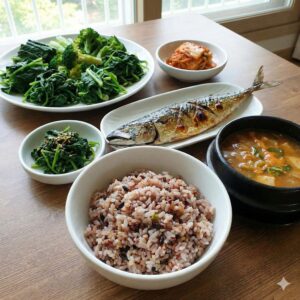
One of the biggest mistakes I made early on was giving my father fruit juices and concentrated vegetable extracts. I thought I was being a good son. I was wrong. When you strip the fiber away and turn fruit into liquid, the sugar enters your bloodstream instantly. I call this the “Tsunami Effect.” Your pancreas has to work overtime to manage that sudden flood. Now, we skip the juice and eat the whole fruit—skin and all.
The most effective change we made was the “Reverse Eating Order.”
Step 1: Start with fiber (salads, cucumbers, or broccoli).
Step 2: Move to protein and fats (tofu, fish, or lean meat).
Step 3: Finish with carbohydrates (grains or starchy vegetables).
By the time the carbs hit your stomach, the fiber and protein have already formed a protective web in your gut, slowing down the absorption of sugar. I actually tested this with a continuous glucose monitor, and the difference was staggering. The spike was barely a hill compared to the mountain it used to be.
Safe Foods vs. High-Risk Foods: The Practical Comparison
I compiled this list based on various clinical nutrition guides to help you make split-second decisions at the grocery store.
| Category | Safe to Enjoy (Low GL) | Use Caution (Medium GL) | Best to Avoid (High GL) |
| Grains | Steel-cut oats, Quinoa, Barley | Brown rice, Buckwheat noodles | White bread, Rice cakes, Instant ramen |
| Vegetables | Broccoli, Spinach, Cabbage | Pumpkin, Corn | Pickled vegetables with heavy sugar |
| Fruits | Blueberries, Green apples, Tomatoes | Bananas, Grapes | Watermelon, Canned fruits in syrup |
| Protein | Tofu, Eggs, White fish, Chicken breast | Boiled pork slices | Ham, Sausages, Bacon |
Reference: Mayo Clinic – Diabetes Diet, Eating Out, and Alcohol
https://www.mayoclinic.org/diseases-conditions/diabetes/in-depth/diabetes-diet/art-20044295
My Biggest Failure: Why “Healthy” Snacks Can Be Dangerous
I have a confession to make. I once bought a huge box of brown rice cakes for my father, thinking they were the perfect healthy snack. I was devastated to find out later that the process of puffing or grinding grains into flour actually breaks down the structure so much that it spikes blood sugar almost as fast as pure sugar.
It is the same with potatoes. A boiled potato is okay, but a baked potato is worse, and mashed potatoes are the most dangerous. If a food feels soft and melts in your mouth, it will likely melt into your bloodstream just as fast.
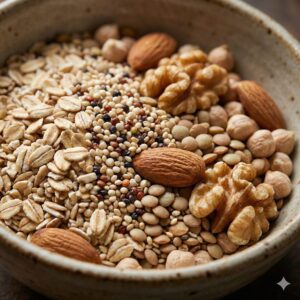
I also learned the hard way about nuts. While they are great for blood sugar, they are very calorie-dense. I used to let my father snack on them all day until I realized the extra calories were causing him to gain weight, which actually makes insulin work less effectively (insulin resistance). Now, I pre-portion them into tiny containers—no more than 15 nuts a day.
Your 3-Step Daily Checklist for Stable Energy
- Start your morning with a glass of warm water followed by raw vegetable sticks.
- Never sit still after a meal. Walk for just 10 minutes starting 15 minutes after you finish eating. This tells your muscles to burn the sugar you just consumed.
- If you need a snack, reach for a hard-boiled egg or plain Greek yogurt rather than something crunchy or sweet.
How have you been feeling lately? Do you find yourself fighting off an overwhelming sleepiness after lunch, or do you feel a constant, unquenchable thirst? These aren’t just quirks of aging; they are your body’s way of screaming for help. Don’t ignore the signals like I almost did.
Frequently Asked Questions (Q&A)
Q1: Is coffee strictly forbidden?
Not at all! In fact, some studies suggest that black coffee might improve metabolism. However, avoid the 3-in-1 creamers and sugar. Also, try to drink it before noon so it doesn’t ruin your sleep, as poor sleep can raise stress hormones and increase blood sugar. ☕
Q2: Can I eat as much meat as I want?
Protein is vital, but high-fat cuts can be problematic. Saturated fats can interfere with insulin sensitivity. Choose lean options like steamed fish, boiled chicken, or tofu instead of fried or greasy meats. 🍗
Q3: If I take medication, do I still need to be this strict?
Think of medication as a safety net, not a license to eat anything. If you don’t manage your diet, you will eventually need higher doses of medication, which puts more strain on your organs. A good diet gives your pancreas a chance to rest and recover. 💊

The truth is, a “diabetes diet” is actually just the healthiest way for any human being to eat. Since I started following these rules alongside my father, I have felt more energetic and lighter than I have in years. Having a family history isn’t a curse; it is a wake-up call to live a better, more intentional life.
Please, don’t let a single bad meal discourage you. If you slipped up today, just start again with the very next bite. Pick up that piece of broccoli first. I am rooting for you every step of the way!
Do you have a favorite blood sugar-friendly recipe, or is there a specific food you are unsure about? Leave a comment below and let’s figure this out together!
Authority References:
American Diabetes Association: https://diabetes.org
CDC – Diabetes Meal Planning: https://www.cdc.gov/diabetes/managing/eat-well/meal-plan-method.html
Mayo Clinic Health Information: https://www.mayoclinic.org
👉Related Posts
Stop Starting with Rice: How the ‘Reverse Eating Order’ Saves Your Blood Sugar