Hello everyone! It’s your friendly neighborhood health enthusiast, Cooldy, here to chat about something that’s been on my mind lately. 😊
How have you been feeling these days? Is your body feeling a bit heavier, or do you find yourself getting tired more easily than before? We often chalk these things up to just “getting older,” but what if I told you there’s a secret savings account in your body that determines how much energy and freedom you’ll have in the coming years? I’m talking about ‘Muscle Pension.’ Just as we save money for retirement, we need to save muscle to ensure a vibrant, independent life. Today, let’s dive deep into the world of muscle health and how to prevent Sarcopenia—the fancy medical term for muscle loss. Grab a cup of tea, and let’s get started!
💪 Why Muscle is the New Currency
In the past, people used to think that losing muscle was just a natural part of aging, like getting gray hair. But modern science tells a different story. Around the age of 30, our muscle mass starts to decline gradually. By the time we hit our 60s, that decline can turn into a steep drop-off.
Why does this matter? Because your muscles are so much more than just “engines” for movement. They are your body’s largest metabolic organ. They help regulate blood sugar, burn calories even when you’re resting, and act as a shock absorber for your joints. When muscle mass drops too low—a condition called Sarcopenia—it’s not just about weakness. It increases the risk of falls, fractures, diabetes, and even heart disease. This is why many doctors now treat Sarcopenia as a serious health condition, not just a symptom of age.

🧐 The “Finger-Ring” Test: Are Your Muscles Safe?
You might be wondering, “Cooldy, how do I know if I’m losing too much muscle?” Well, you don’t need an expensive MRI to get a general idea. Here are three simple ways to check your muscle status right at home:
- The Finger-Ring Test: This one is fascinating! Take both your hands and make a circle using your thumbs and index fingers. Now, try to wrap that circle around the widest part of your calf. If your calf is much thinner than the circle (meaning there’s a lot of gap), you might be at a higher risk of muscle loss. If the circle barely fits or your calf is thicker, you’re in a better spot!
- The Five-Times Chair Stand: Sit in a sturdy chair with your arms crossed over your chest. Stand up and sit down five times as fast as you can. If it takes you longer than 11 or 12 seconds, it’s a sign that your lower body strength needs a little “top-up.”
- The Crosswalk Speed: Next time you’re at a crosswalk, notice if you’re struggling to keep up with the pace of the light. If you find yourself consistently lagging behind others or barely making it across before the light changes, your walking speed—a key indicator of muscle health—might be declining.
How did you do? If the results weren’t perfect, don’t worry! The beauty of muscle is that it’s never too late to start “saving.”
🥩 Building Blocks: The Ultimate Protein Strategy
If you want to build a house, you need bricks. If you want to build muscle, you need protein. But it’s not just about eating a big steak once a week. It’s about being strategic.
1. The Magic Number: How Much?
Most experts recommend consuming about 1.2 to 1.5 grams of protein per kilogram of body weight. So, if you weigh 60kg, you’re looking at roughly 72g to 90g of protein every day. To put that in perspective, one egg has about 6g of protein. That’s a lot of eggs! This is why we need to diversify our sources.
2. The Distribution Secret
Our bodies are a bit picky—they can only absorb so much protein at one time (usually around 20-30g). If you skip protein at breakfast and eat a giant chicken dinner, your body can’t use all that evening protein for muscle building. The key is to split your intake evenly across breakfast, lunch, and dinner. Try adding Greek yogurt or eggs to your morning routine!
3. Animal vs. Plant Protein
Animal proteins (meat, fish, dairy) are “complete,” meaning they have all the essential amino acids. Plant proteins (beans, tofu, nuts) are great for fiber and heart health. For the best results, I recommend a mix: about one-third animal protein and two-thirds plant protein.
💊 The Secret Helpers: Leucine and Vitamin D
Even with enough protein, your muscles need a “green light” to start growing. That light is an amino acid called Leucine.
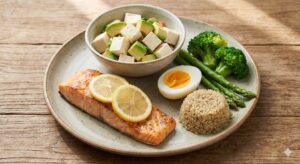
Think of Leucine as the foreman on a construction site. Without the foreman’s signal, the workers (other amino acids) won’t start building. Foods high in Leucine include soybeans, beef, salmon, and peanuts. If you find it hard to get enough through food, some people look for protein powders specifically fortified with Leucine.
And don’t forget Vitamin D! It’s like the electricity that keeps the construction site running. Vitamin D helps your muscles contract properly and improves overall strength. Since it’s hard to get enough from food alone, try to catch 20 minutes of midday sun or talk to your doctor about a supplement.
🏋️ Your “At-Home” Muscle Workshop
You don’t need a gym membership or heavy weights to get stronger. In fact, using your own body weight is one of the safest and most effective ways to build “Muscle Pension.”
1. The Wall Sit (Invisible Chair)
Lean your back against a smooth wall and slide down until your knees are bent at about a 90-degree angle (or as far as is comfortable). Hold it for 10 to 20 seconds. This is amazing for your thighs and glutes without putting too much pressure on your joints.
2. Calf Raises
While you’re waiting for the kettle to boil or brushing your teeth, slowly rise up onto your tiptoes and hold for a second, then lower back down. Your calves are often called the “second heart” because they help pump blood back up to your upper body!
3. Countertop Push-ups
If floor push-ups feel impossible, use your kitchen counter! Stand a few feet back, place your hands on the edge of the counter, and perform a push-up. This builds chest, shoulder, and arm strength safely.
Note: What is “Core” strength? You’ll hear this a lot. It refers to the muscles in your stomach, back, and hips. Think of it as the “trunk” of your tree—if the trunk is strong, the branches (your arms and legs) can move much more easily!

💤 Rest and Hydration: The Silent Partners
Here is a secret that many people miss: Muscle isn’t built while you’re exercising. It’s built while you’re sleeping!
When you sleep, your body releases growth hormones that repair the tiny tears in your muscles caused by exercise, making them stronger than before. Aim for 7-8 hours of quality sleep. If you’re tossing and turning, try to limit caffeine in the afternoon.
Also, drink your water! Muscles are about 75% water. If you’re dehydrated, your muscles become weak and prone to cramps. Think of a grape versus a raisin—you want your muscles to be plump and hydrated like a grape!
🌟 Cooldy’s Final Encouragement
Friends, building muscle isn’t about looking like a bodybuilder. It’s about freedom. It’s about being able to lift your grandkids, carry your own groceries, and walk through a beautiful park without fear of falling.
Every step you take, every extra bit of protein you eat, and every squat you do against the wall is a deposit into your “Muscle Pension.” Your future self will thank you for the strength and independence you’re building today.
I’m rooting for you! Start small—maybe just five calf raises today. You’ve got this! If you have any questions or want to share your own tips, leave a comment below. Let’s stay strong together! 😊

🔗 Reliable Resources
- National Institute on Aging – Exercise and Physical Activity
- Mayo Clinic – Sarcopenia: What you need to know
- Harvard Health – Preserve your muscle mass
👉Related Posts
Stop Just Walking! Boost Muscle and Lower Blood Sugar with the ‘3-Minute Interval Walking’ Method
The Silent Threat: Essential Diet and Exercise for Preventing Age-Related Muscle Loss (Sarcopenia)