- Beyond Books: Libraries are shifting into “community hubs” that offer health-tech workshops, legal aid, and social programming specifically designed for older adults.
- Universal Design: Look for facilities that prioritize accessibility through height-adjustable furniture, high-contrast signage, and acoustic dampening to ensure comfort for all mobility and hearing levels.
- Proactive Engagement: You can maximize these resources by requesting specific “navigator” services that help you bridge the gap between digital library tools and your personal daily needs.
By 2026, the public library is no longer just a repository for books; it is evolving into a critical piece of community infrastructure designed to foster “aging in place.” For adults aged 60 to 80, this shift represents a significant opportunity to access resources that support health, lifelong learning, and social connectivity in a single, accessible location. Understanding these trends allows you to advocate for your own needs and make the most of the services currently being rolled out in urban and rural centers globally.
The Shift Toward “Third Space” Community Hubs
The concept of a “third space”—a location that is neither work nor home—has become the primary architectural and social goal for libraries heading into 2026. For older adults, this means libraries are increasingly prioritizing spaces that allow for long-duration stays without the pressure to purchase goods or services. Unlike a café, these spaces are designed for comfort, safety, and silence or social interaction as needed.
In real-life application, this looks like the integration of “living room” zones. These areas often feature:
- Ergonomic Seating: Chairs with high backs and firm cushions that provide lumbar support, making it easier to stand up after prolonged periods.
- Acoustic Control: Strategic use of sound-absorbing panels to reduce background noise, which is essential for those with hearing sensitivities.
- Integrated Technology: Charging ports at every seat and high-speed, simplified Wi-Fi access that does not require complex authentication steps.
What you can do: When visiting your local library, look for these zones. If they are missing, consider speaking with the library board or management about “universal design” initiatives, which are currently being funded by many municipal governments to make public spaces more inclusive.
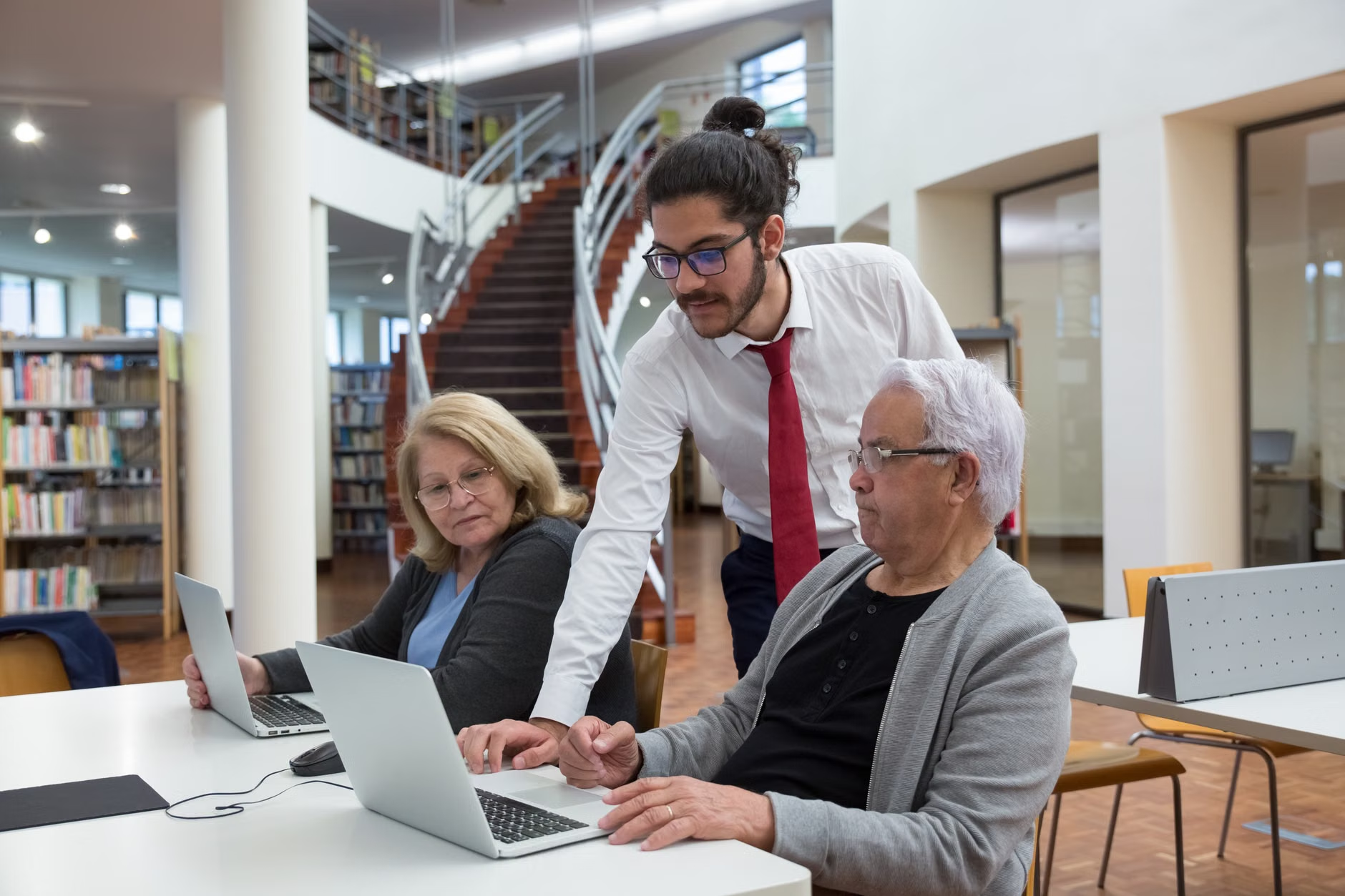
One of the most significant 2026 trends is the library’s role as a health-literacy partner. Libraries are increasingly acting as “first-stop” hubs where you can find verified health information and navigate digital health services without the intimidation of a clinical environment.
Many libraries are now training “information specialists” to act as health navigators. These are not medical professionals, but they are skilled in helping you:
- Identify Credible Sources: Distinguishing between peer-reviewed medical data and marketing-driven health myths.
- Access Telehealth: Providing private “tele-booths” where you can conduct video appointments with your doctor in a quiet, high-speed, and secure environment.
- Digital Health Portals: Assisting you in setting up and navigating your government or private health insurance online dashboards.
Common Mistake: Many older adults assume that libraries only provide access to computers. In 2026, the value is in the curated guidance. You do not need to struggle with a new health portal alone; schedule a “one-on-one technology assistance” session, which is now a standard offering in most modern municipal library systems.
Universal Design and Mobility Accessibility
Accessibility in 2026 is moving beyond just “wheelchair ramps.” It is about the holistic experience of moving through a space. This includes sensory accessibility and cognitive-friendly design.
| Feature | 2020 Standard | 2026 Trend |
|---|---|---|
| Signage | Small, low-contrast text | High-contrast, large-format, and tactile (Braille/raised) signage |
| Furniture | Fixed height tables | Height-adjustable tables for wheelchairs and varied standing heights |
| Lighting | Uniform fluorescent | Layered, glare-free lighting with color-temperature control |
This comparison highlights a transition from “meeting the code” to “optimizing for comfort.” If you find that lighting in your local library causes eye strain or that the aisles are too narrow for comfort, you are likely experiencing a facility that has not yet adopted 2026 universal design standards. These standards are not just for those with mobility aids; they are for everyone, as they reduce physical fatigue and improve navigation for all.

Intergenerational Programming and Skill Exchanges
A major trend for 2026 is the formalization of “Skill Exchanges.” Libraries are facilitating programs where older adults teach traditional skills (such as woodworking, gardening, or financial management) to younger generations, while younger adults teach modern digital skills or language nuances in return.
This is not just a social activity; it is a proven method for maintaining cognitive health and community relevance. The “intergenerational” aspect is critical because it breaks down the barriers of age-segregated social life.
How to participate effectively:
- Identify your expertise: What is a hobby or career skill you possess that you could teach? Libraries are looking for volunteers to run 4-week workshop series.
- Request specific training: If you want to learn, for example, how to use AI-assisted tools for genealogy research, request this as a community workshop. Libraries in 2026 are increasingly responsive to direct community input.

As governments move more services online—from tax filings to pension updates—the library is your most reliable “digital bridge.” In 2026, libraries are becoming centers for “Digital Empowerment.” This is more than just basic computer skills; it is about protecting yourself online.
Consumer Protection: Libraries are increasingly providing workshops on identifying digital scams, managing secure passwords, and understanding data privacy. If you are ever unsure about an email or a website, the library’s information desk is a safe, neutral space to verify these items.
Practical Step: Before your next visit, check your local library’s website for an “Events” or “Workshops” calendar. Look specifically for “Digital Literacy,” “Cybersecurity for Seniors,” or “Government Service Assistance” tags. These programs are often free and provide the most up-to-date information on protecting your identity.
Insights on Library Sustainability and Future-Proofing
A frequently overlooked variable is the library’s role in climate resilience. In 2026, many libraries are designated as “Cooling and Warming Centers.” If you live in an area prone to extreme weather, your library is likely equipped with backup power and climate control systems that are designed to be accessible during emergencies.
Hidden Inconvenience: During peak demand (such as extreme heat waves), these spaces can become overcrowded. The best strategy is to familiarize yourself with the library’s “Emergency Preparedness” policy before a crisis occurs. Ask the staff: “If this facility becomes a cooling center, what is the protocol for access?”
Conclusion
The library of 2026 is a dynamic, essential partner in your daily life. It is no longer a place of quiet isolation but a vibrant community hub that offers health navigation, digital training, and intergenerational connection. By treating the library as a primary resource rather than a secondary one, you can significantly enhance your quality of life, maintain your digital independence, and stay connected to your community. Your next step is simple: visit your library’s website or front desk this week and ask for their “Senior Programming Schedule” or “Accessibility Guide.”
Frequently Asked Questions
1. Do I need to be a resident of the city to access library workshops?
Most public libraries operate on a “reciprocal borrowing” or “open access” policy for workshops, but rules vary by jurisdiction. In many countries, like the UK or Canada, you can attend events regardless of residency, but you may need a local library card to borrow physical materials or access specific digital databases. Check your local council or municipal library website for residency-specific event policies.
2. How can I request a specific workshop or service if it is not currently offered?
Libraries are increasingly community-led. You can submit a request through the library’s “Suggest a Program” form, often found on their website. If you can gather a small group of interested peers, the likelihood of the library hosting that program increases significantly, as they are measured by their ability to meet community needs.
3. Are these digital services truly secure for handling sensitive information like taxes?
Public library computers are generally wiped of user data after each session, but for sensitive tasks, you should always exercise caution. Use the library’s secure Wi-Fi rather than public, unsecured networks. For tax or financial services, many libraries now offer “clean-room” terminals or dedicated secure laptops that are specifically configured for high-privacy tasks. Always ask the staff if they have a “secure terminal” for private financial work.
Sources: