Do you ever feel like your body is falling apart, even though the doctor says everything is “fine”? “Oh, my knees, my back… I guess this is just part of getting older,” we often sigh, brushing it off as a natural part of aging. But what if those nagging aches aren’t just about your joints or muscles? What if your body is actually sending out a “S.O.S.” signal from your heart? 😟
There’s a famous story often shared in medical circles about a man in his 70s named Mr. Miller. He was always healthy and active, but suddenly he started suffering from severe indigestion and a heavy feeling in his chest. He went to several specialists, had three endoscopies, and even went through a full-body scan. The results? Perfectly clean. His family started to think he was just being “difficult” or “overly sensitive.” It was only much later that they discovered his real issue wasn’t a stomach bug—it was ‘Masked Depression.’
Today, I, Cooldy, want to dive deep into this mysterious condition that hides behind physical pain and forgetfulness. Let’s peel back the layers and find out what’s really going on beneath the surface. 🕵️♂️✨
When the Mind Wears a Disguise: What is ‘Masked Depression’?
When we think of depression, we usually imagine someone crying all day, staying in bed, or feeling overwhelmed by sadness. But Masked Depression is exactly what it sounds like: a state where the emotional pain is hidden behind a “mask” of physical symptoms. 🎭
For many people, especially those raised in cultures or generations where expressing feelings was seen as a sign of weakness, the mind finds another way to speak. Instead of saying “I feel lonely” or “I feel sad,” the body screams through a headache, back pain, or digestive issues. Professionals call this Somatization.
※ What is Somatization?
It’s a process where psychological distress or internal conflict is expressed through physical (somatic) symptoms. Essentially, your mind is “translating” emotional pain into physical pain.
Neuroscientists have found that the parts of our brain that process emotional pain and physical pain actually overlap. When the heart is hurting too much, the brain can get confused and think, “Ouch! My stomach must be what’s hurting!” In Mr. Miller’s case, his “tight chest” was actually the physical manifestation of his suppressed anxiety and sadness.
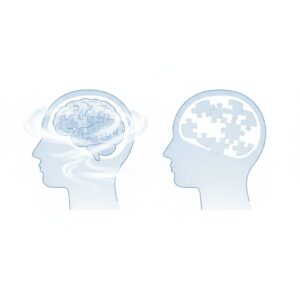
The Great Imposter: Is it Dementia or ‘Pseudodementia’?
One of the most frightening “masks” of depression as we age is ‘Pseudodementia.’ This isn’t real dementia, but it causes such significant cognitive decline—like forgetfulness and confusion—that it looks exactly like the real thing. It’s heartening to know that among people who visit clinics fearing they have Alzheimer’s, about 20-30% are actually suffering from depression and can fully recover their memory once the depression is treated. 🧠💡
So, how can you tell the difference between real dementia and this “fake” version? There are some fascinating clues:
- Awareness of Memory Loss:People with actual dementia often don’t realize they are forgetting things. They might try to hide it or get angry when family members point it out. On the other hand, those with “Pseudodementia” (Depression) are very worried about their memory. They’ll say things like, “I’m so worried, I can’t remember anything lately. Do I have Alzheimer’s?”
- The “I Don’t Know” Response:If you ask a dementia patient a question, they might try hard to answer, sometimes making up stories to fill the gaps. A person with depression often doesn’t have the energy to try. They’ll simply sigh and say, “I don’t know,” or “I don’t remember,” giving up quickly because they feel unmotivated.
- Speed of Change:Dementia usually progresses very slowly over several years. Pseudodementia can appear quite suddenly, with memory and mood dropping significantly over just a few months.
Why Does My Body Hurt So Much? The Science of Serotonin
Here’s a bit of fascinating brain science for you. You’ve probably heard of Serotonin, often called the “happiness hormone.” But did you know it also acts as a natural painkiller? 💊
When your serotonin levels drop due to depression, your “pain threshold” lowers. This means a minor knee ache that you would normally ignore suddenly feels like a sharp, unbearable pain. Your brain’s volume knob for pain is turned way up.
Furthermore, did you know that about 90% of your serotonin is produced in your gut, not your brain? This is why scientists call the gut our “Second Brain.” If your mind is troubled, your gut health suffers, and if your gut is unhappy, your mood plummets. It’s a two-way street that explains why so many people with masked depression complain of stomach issues.
Have You Heard of ‘Broken Heart Syndrome’?
There is a real medical condition called Takotsubo Syndrome, or ‘Broken Heart Syndrome.’ It was first identified by Japanese doctors. When someone experiences an extreme emotional shock—like the loss of a loved one—the left ventricle of the heart can actually change shape, ballooning out like a traditional Japanese octopus trap (Takotsubo). 🐙💔
The heart isn’t diseased in the traditional sense; it’s literally physically deformed by the sheer weight of grief. It’s a powerful example of how our emotions can physically reshape our organs. Masked depression works in a similar, though often more subtle, way by putting constant stress on our systems.
The ‘Mind Vaccine’: Daily Habits to Unmask and Heal
The good news is that masked depression is highly treatable. Along with professional help, here are some scientifically proven “Mind Vaccines” you can start today. 💉😊
1. Catch the 10 AM Sunlight
Your brain’s pineal gland is very sensitive to light. Exposure to bright morning sun helps produce serotonin during the day and sets you up to produce Melatonin (the sleep hormone) at night. Take a 20-minute walk around 10:00 AM without sunglasses. Let that light stimulate your neural pathways!
2. Feed Your Second Brain (The Gut)
Since your gut produces most of your serotonin, eat for your mood!
- Probiotics: Yogurt and fermented foods help healthy bacteria flourish.
- Tryptophan-rich foods: Eat bananas, nuts (walnuts, almonds), and eggs. Tryptophan is the essential amino acid your body needs to build serotonin. A warm glass of milk before bed can also be very soothing. 🥛🍌
3. The 3-Minute Breathing Trick
When we are anxious or in pain, our breathing becomes shallow. Try the ‘4-2-6 Rule’: Inhale through your nose for 4 seconds, hold for 2 seconds, and exhale very slowly through your mouth for 6 seconds. This signals your parasympathetic nervous system to calm down, telling your brain, “We are safe now.”
4. Rewire with a ‘Gratitude Journal’
Our brains have a “negativity bias”—we notice bad things faster than good ones. To fix this, we have to manually “rewire” the brain. Every night before sleep, write down just three tiny things you’re grateful for. “The coffee was hot,” “I saw a pretty flower,” or “The bus arrived on time.” After 21 days, your brain will start looking for the positive automatically. 📝✨

Moving from “It Hurts” to “I Need a Hug”
People suffering from masked depression are often crying out for help through their physical pain. If you or someone you know is constantly visiting the doctor for vague pains or worrying about their memory, don’t dismiss it.
Saying “The doctor said you’re fine, so stop complaining” is the worst thing we can do. Instead, try asking: “How has your heart been feeling lately? You’ve been going through a lot, and sometimes the body feels what the mind can’t say.” 🫂
A moment of genuine connection and a warm hug can sometimes be more effective than a bottle of painkillers. We all deserve to live without masks, feeling healthy in both body and soul.
Please, don’t suffer in silence. A “cold of the heart” is nothing to be ashamed of—it’s just a sign that you need a little extra care. Cooldy is cheering for you and your journey back to a bright, unmasked smile! 🌟

Reliable Resources for Further Reading
- Mayo Clinic – Depression in Older Adults (https://www.mayoclinic.org) – Comprehensive guide on symptoms and treatments.
- Harvard Health – The Gut-Brain Connection (https://www.health.harvard.edu) – Understanding how your digestive system affects your mood.
- National Institute on Aging (NIA) (https://www.nia.nih.gov) – Resources on distinguishing between depression and dementia.
- Mental Health America (MHA) (https://www.mhanational.org) – Tools for screening and finding mental health support globally.
👉 Related Posts